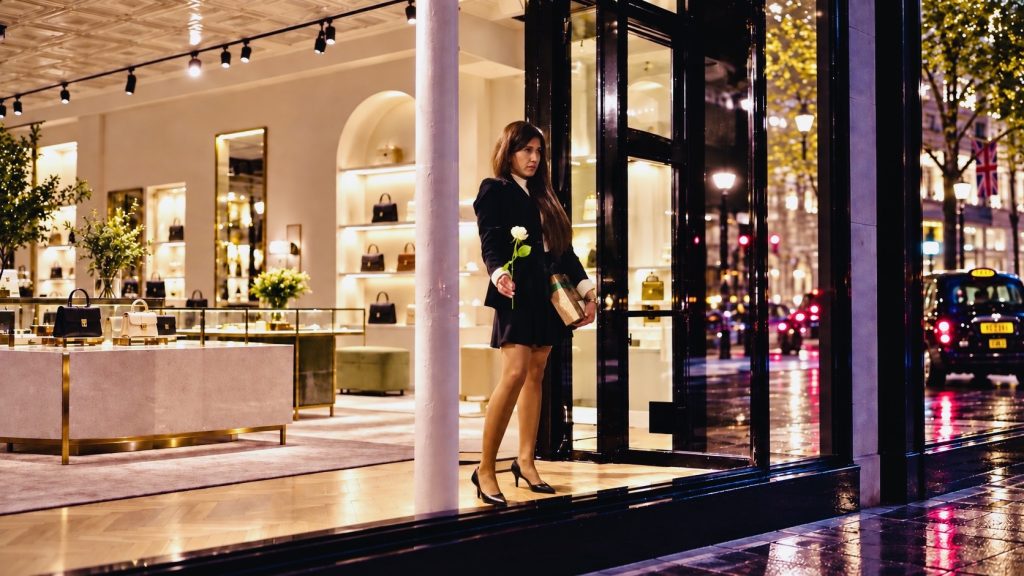
Luxury retail, London United Kingdom. © Picture House Films UK
There is something revealing about a good shop window. It tells you, often in seconds, whether a business understands itself.
Before the customer enters, before a conversation begins and before a sale is made, the window has already done part of the work. It communicates taste, confidence, positioning and intent.
That is what has always interested consumers about retail. Some of the best commercial ideas are hiding in ordinary places.
A shop window is not simply decoration, It is strategy made visible.
The strongest windows do not try to explain everything. They understand discipline. They know when to create intrigue, when to reveal just enough and when to leave space for imagination to do the rest, the principle extends far beyond retail.
In business, there is often too much focus on what we want to say. Strong brands think just as carefully about what they want people to feel, that difference matters.
A customer may forget the exact wording of an advert, but remember the atmosphere surrounding a brand. They may forget a campaign headline, but remember the colour, the service, the packaging, the room, the tone of voice or the way something was presented. Those details are not superficial. They become part of commercial memory.
For years, marketing has been moving towards speed, optimisation and efficiency. Faster funnels, more content, more touch points, more data and more opportunities to place a message in front of someone. All of that has value, but efficiency alone does not create desire.
Desire often begins with a pause, a customer stops walking, they look again, they notice a detail, they wonder what is inside, they imagine the product in their own life. That moment is important because it is voluntary.
The customer has not been interrupted, they have chosen to look, that is a very different kind of attention. It is also why the physical world still has so much to teach modern marketing.
A shop window understands framing, a department store understands movement, a hotel lobby understands atmosphere, a restaurant understands anticipation, a good salesperson understands timing.
These ideas existed long before we gave them names such as customer journey, experiential marketing and brand engagement.
Commerce has always been behavioural, the tools change, people do not change quite as quickly.
We are still drawn towards curiosity, we still notice confidence. We still respond to familiarity, we still make emotional judgements before rational ones.
A business that understands those instincts has an advantage. That does not mean every brand should try to become luxurious or theatrical. It means every brand should understand the experience it is creating.
What does someone notice first? What stays in their mind? What makes them trust the business? What makes them curious enough to move closer? What makes the brand feel considered rather than accidental? Those questions matter whether the business sells handbags, software, food, financial services or ideas.
The environment may change, but the principle does not. Good marketing gives people a reason to move towards you. That is why discipline is often more powerful than excess.
A shop window crammed with everything a business sells can become invisible. The eye does not know where to land, the same is true online. More banners, more messages, more popups and more competing calls to action do not necessarily create more persuasion, sometimes they create confusion, clarity is commercial.
A strong brand makes choices, it decides what deserves attention and what does not. It understands that presentation is not merely cosmetic. presentation tells the customer how seriously a business takes itself.
That is particularly important in a world where polished content has become easier to produce. When almost anyone can create something visually competent, judgement becomes more visible. The question is no longer simply whether something looks professional, the question is whether it feels intentional. That is where brand character begins.
A recognisable business has its own rhythm, its own standards and its own way of presenting itself. You begin to know it before you read the name. That kind of recognition is valuable because it reduces the work a brand has to do every time it appears. The shop window understood that years ago.
A good reputable one does not shout for attention, it earns it. It creates enough interest for somebody to stop, then enough confidence for them to step inside, perhaps that is the lesson worth carrying into modern marketing.
The most powerful brands do not simply ask to be noticed, they give people a reason to stop, look, pause and think.
Nadia Alexander-Khan
Global Market Researcher